How to Analyze Your Chess Games and Actually Improve
Your accuracy score isn’t a practice plan. Turn a few important decisions into lessons you can actually use in your next game.
 GlassKnight

You’ve finished a game. The review gives you an accuracy score, a few mistakes, and a move you wish you had played. Now what?
For a useful review, set a more specific goal than “look through the game.” Leave with one decision you would handle differently next time, and a way to practice it.
Here’s a routine to try after your next completed game. Use it as a quick first pass, then spend longer on positions that deserve it.
Your accuracy score isn’t your homework
Accuracy can help summarize a game, but it doesn’t tell you what to practice.
Lichess explicitly warns against treating accuracy like a school-test grade. Complex positions can make good moves harder to find, while one-sided positions can produce high accuracy without particularly precise play. 1
So don’t finish your review at “I scored 78%.” Ask a question you can act on: Did I overlook an undefended piece? Misjudge an exchange? Miss my opponent’s threat?
A score describes the game. A specific question gives your review a direction.
1. Capture your thinking before checking the answer
Choose a moment when you felt uncertain, surprised, or especially confident. Before revealing the recommended move, write one sentence about your decision:
“I thought the pawn was free, and I didn’t check what happened after taking it.”
That gives you something to test. WGM Dina Belenkaya recommends examining your own thoughts and alternatives before bringing in the engine. The point is to compare your reasoning with the analysis, rather than replace it with the answer. 2
You don’t need pages of notes. Start with the decision you most want to understand.
2. Choose a few moments, not every imperfection
For a short review, try selecting up to three positions: one costly mistake, one missed opportunity, and one move you’re proud of. The last one deserves attention.
Did you find that good move for the right reason? Did you see the opponent’s best response, or did the game work out more favorably than you expected?
Try completing this sentence for each position: “This moment mattered because…”
“The engine didn’t like my move” is a starting point. “Moving my bishop left the rook undefended” is a lesson you can investigate.
You can always return for deeper analysis. For this first pass, give a few decisions enough attention to understand them.
3. Investigate your move, not just the recommended one
Suppose the review recommends a different move. Don’t immediately memorize it. Compare the two ideas.
Play out your original choice against the strongest reply you can find. Then examine the recommended alternative. Belenkaya’s analysis guide similarly encourages testing your variations and exploring the ideas behind engine suggestions. 2
Keep asking: “What does this move allow or prevent?”
Stop when the important consequence becomes clear: a piece is lost, an attack is stopped, a king becomes vulnerable, or an endgame changes.
When the explanation is still unclear, mark the position for a deeper session. “I haven’t understood this yet” is more useful than pretending a long engine line makes sense.
4. Turn the mistake into a trigger
“Stop blundering” isn’t an instruction you can follow. A better lesson connects a recognizable situation to an action:
| What happened | What to do next time |
|---|---|
| I moved a piece that was defending something important. | Before moving a defender, check what it leaves behind. |
| I missed a knight fork. | When valuable pieces sit near an enemy knight, inspect its possible jumps. |
| I grabbed a pawn and overlooked a threat. | Before taking material, check the opponent’s forcing replies. |
Use this template: “When I notice ___, I will check ___.”
For example: “When my opponent moves a defending piece, I will check what it stopped protecting.”
That’s a more useful souvenir than remembering which square your bishop belonged on in one particular game.
5. Give yourself another attempt
Once you understand the idea, return to the position before the mistake. Hide the continuation and try again. Don’t stop at naming the first move. Explain the likely reply and why your continuation works.
There’s a broader learning principle behind this approach. In experiments using written passages (not chess positions), Roediger and Karpicke found that recalling information produced better delayed retention than repeatedly studying it. That supports trying to retrieve a lesson, rather than only rereading it; it is not evidence of a particular chess-rating gain. 3
For your chess practice, try returning to the position another day. Then attempt a different position involving the same idea.
The question isn’t only “Do I remember the answer?” It’s “Do I recognize what makes this idea work?”
Bring the review and the practice together
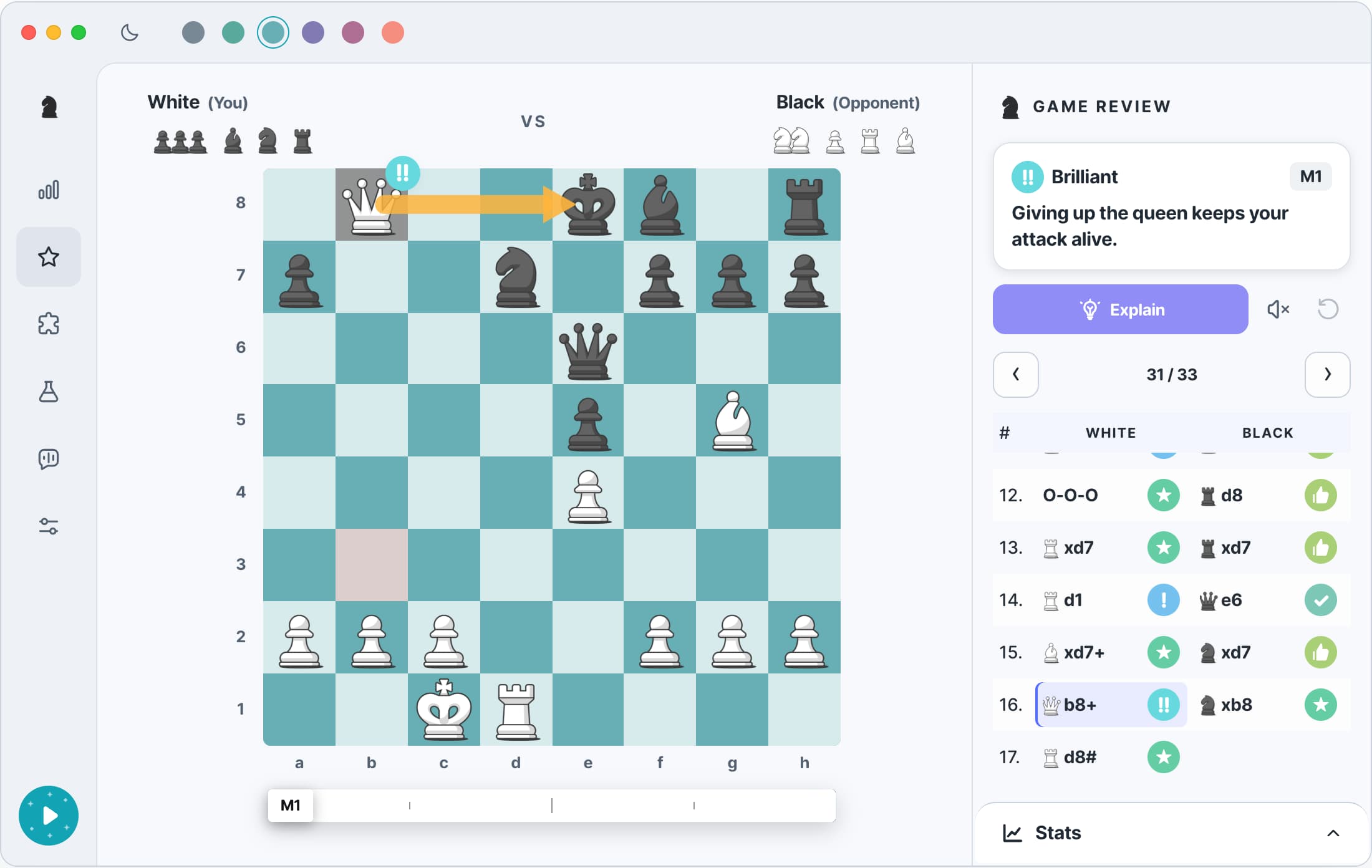
In GlassKnight, start with the Game Review for a coached or imported game. Use the move grades and explanations to investigate an important decision. Revisit the moments you found or missed through Highlights, then use Game Puzzles to practice lessons connected to your game.
Give yourself one small assignment before moving on: “In my next game, I’m checking what becomes undefended after each exchange.”
Keep it specific enough that you can actually notice yourself doing it. A useful review doesn’t end with a verdict on your last game. It ends with something to try in your next one.